
Differences in the Application of Containers in Sea and Road Transport: A Technical Analysis for Logistics 2026
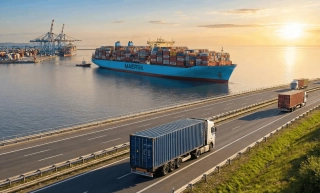
In 2026, intermodal transport constitutes the backbone of global trade, and the standardization of container units is perceived as the foundation of procedural fluidity. However, from the perspective of logistics engineering, the transition of a container from a ship's deck to a road semi-trailer is a critical moment of a paradigm shift in loads, safety, and legal requirements. Understanding the fundamental differences in operational specifics between maritime and land transport is essential for avoiding operational errors that generate unplanned costs and jeopardize the integrity of the supply chain.
Structural Challenges: Static vs. Dynamic Forces
In maritime transport, the dominant technical parameter is stacking strength. During transport, a sea container must support the weight of up to 10 layers of units stored above it, which generates immense pressure on the corner castings and corner posts. In this environment, the key parameter is the MGW (Max Gross Weight), which currently stands at 30,480 kg for standard 20' and 40' units.
Conversely, containerized road transport is the domain of dynamic forces. In this case, attention must be paid to the distribution of axle loads on the container semi-trailer. Rapid braking generates longitudinal stresses that must be absorbed by the locking pins (twist locks). Improper distribution of goods inside the container is the most common cause of a road vehicle combination rollover on curves, even though the same cargo would be completely safe in a ship's hold.
Issues Concerning High Cube Containers and Land Infrastructure
According to current statistics, High Cube (HC) containers with a height of 2.9m constitute nearly 70% of the intermodal fleet. In maritime transport, their additional 30 cm of height is cost-neutral. However, in road transport, after mounting the container on a standard semi-trailer, the total height of the vehicle combination often reaches 4.05 – 4.10 m.
In the logistics industry, this necessitates the use of special semi-trailers which, thanks to a lowered frame profile, allow the vehicle combination to remain within the 4.00 m limit. Exceeding this limit without a special permit for oversized transport results in high fines and the risk of collision with bridge infrastructure.
Legal Aspects and Certification: The CSC Plate
Every unit used in international trade must possess a valid CSC certification. The CSC plate acts as the container's "registration document," confirming its technical fitness for stacking and lifting under full load.
During land transport, safety standards (ISO standards) are of paramount importance, guaranteeing that the walls and roof of the container will not deform under the influence of wind or vibrations during transit. Each container also possesses its own unique identification number – acting as a "PESEL" (national identification) number for the cargo. Thanks to this, in 2026, we can verify the exact location of your goods on a map at any second (Track & Trace system), which practically eliminates the risk of loss.
The Sea Container as a Mobile Stationary Warehouse
In 2026, we observe an evolution of containers retired from maritime operations (so-called "last voyage"), which are becoming stationary container warehouses, e.g., self-storage units. The robust construction made of Corten steel makes these containers unrivaled compared to traditional masonry halls.
For the business client, tightness and insulation are key. In the case of storing temperature-sensitive goods, it is recommended to perform a modification involving internal thermal insulation, whereby the internal temperature will change very gradually, thus ensuring stable storage conditions. A warehouse prepared in this manner is mobile – it can be placed on a construction site on mounting pins or concrete blocks and, upon completion of the project, be transported to another location.
Expert Summary: Unit Selection Strategy for 2026
Maritime transport imposes rigorous standards for strength and corrosion resistance in high-salinity environments, while road transport limits users mainly by the maximum permissible gross weight. The key to success in 2026 is the conscious choice of a supplier who not only delivers the unit but also performs a full technical audit of the client’s needs prior to order fulfillment.
Logistics optimization today requires an understanding of nuances, such as the necessity to reinforce the bottom frame for high-density loads or the verification of the CSC certification validity for planned maritime export. Choosing a properly adapted container (e.g., through specialized thermal insulation or floor reinforcement) allows for the elimination of the risk of property damage and the avoidance of penalties for exceeding normative parameters on the roads. In an era of increasing requirements regarding safety and precision, an engineering approach to every container is becoming the standard that distinguishes market leaders from accidental suppliers.