
45’ HC Container House – Why an additional 1.5 meters constitutes the key to full-scale comfort?
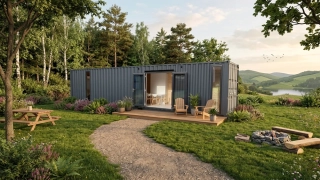
Designing residential facilities based on shipping containers has for years faced a struggle for every centimeter. While the secondary market is saturated with 40’ DV and HC units, it is precisely the less common 45’ HC (High Cube) container that is currently becoming the foundation for investors seeking the largest possible living space without the necessity of joining multiple modules. The problem of lack of ergonomics in the bedroom or the lack of room for living space disappears when an additional 1.5 linear meters of construction is at our disposal.
Technical specification: 40’ HC vs 45’ HC
For a future user, the key parameter is not only the floor area, but the total internal volume, which allows for the installation of thick insulation without sacrificing a high, spacious ceiling. The High Cube (HC) version offers an external height of 2.89 m, which, after the application of floor and ceiling insulation, allows for maintaining an internal height at the level of approx. 2.50–2.60 m – a developer standard.
Comparative table: Structural parameters of High Cube units
| Parameter | 40’ HC Container | 45’ HC Container | Gain / Difference |
|---|---|---|---|
| External length | 12,192 mm | 13,716 mm | + 1,524 mm |
| External width | 2,438 mm | 2,438 mm | 0 mm |
| External height | 2,896 mm | 2,896 mm | 0 mm |
| External area | approx. 29.7 m² | approx. 33.4 m² | + 3.7 m² |
| Usable area* | approx. 24.5 m² | approx. 28.2 m² | + 15.1% |
| Internal cubic capacity | 76.2 m³ | 86.1 m³ | + 9.9 m³ |
What do you gain thanks to the additional 152 centimeters?
In the case of small, compact apartments, 1.5 meters is an additional benefit that may manifest in several exemplary aspects:
Logistical and structural challenges: Turning radius and foundations
The application of a 45’ HC unit carries specific transport requirements. The length of a semi-trailer with such a load exceeds standard operational dimensions in tight urban developments or on winding mountain roads.
The access road should be verified in terms of the turning radius. Semi-trailers for 45’ containers often require an extended rear, which increases the so-called "sweeping" during turns.
Due to the greater length and tare weight of the container (the tare of a 45’ container is approx. 4,800 kg), the use of a minimum of 6 to 8 support points is required. In this case, concrete foundation footings with embedded mounting pins or screw-in steel piles are recommended, which ensures proper floor ventilation and insulation from ground moisture.
Legal and Normative Aspects
Construction of a house from a 45’ HC container is subject to the Building Law Act. Key in this case is the distinction between a temporary facility and a residential building:
If you are planning a year-round house in which the container is to be the only module – choose 45’ HC. These additional 1.5 meters are the boundary beyond which compromise ends and functionality begins. This allows for the separation of a living and sleeping zone without the feeling of being in a "railway carriage". Gain space for daily functioning.